
When Clothing Becomes a Distraction from the Deeper Question
This article examines a recent debate over modesty in church leadership and how conversations about appearance continue to reveal deeper tensions around faith, authority, and expectation within Christian culture.
BY LEAD WRITER AT GRIEFBLOOMS.COM
3 min read
Prelude
Within Black church traditions, the role of a pastor’s spouse has long carried heightened visibility and unspoken expectations. First Ladies are often seen as reflections of the ministry itself, not only in conduct, but in appearance, tone, and presence. These expectations are rarely written, yet they are deeply understood, passed down through culture, custom, and lived experience.
Because of this visibility, conversations about modesty, representation, and leadership tend to surface quickly and publicly. What might be overlooked elsewhere becomes magnified, not out of malice alone, but out of inherited ideas about respectability, responsibility, and spiritual example. When appearance becomes part of the conversation, it is often standing in for something larger, authority, tradition, and the boundaries of belonging.
This context matters, not to single out a community, but to understand why these debates continue to reappear. They are not simply about clothing. They are about the weight placed on women’s bodies to carry collective meaning, and the tension between evolving self-expression and longstanding expectations within the life of the church.
When Clothing Becomes a Distraction from the Deeper Question
In Christian spaces, discussions about faith often claim to focus on the heart, on character, on spiritual maturity. Yet time and again, the conversation gets pulled back to appearances. What someone wears, how much skin shows, what is considered appropriate, and who gets to decide. These moments are not new, and they tend to surface most sharply when women in visible leadership roles are involved.
At the core of these debates is not fabric or fashion, but expectation. Who carries the weight of representing holiness. Who is allowed personal expression. And whose bodies become public property for commentary in the name of faith.
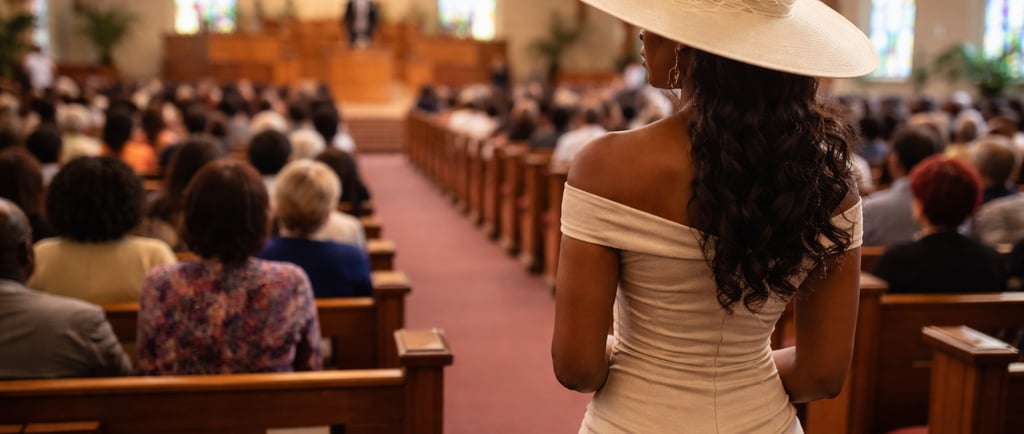
Recently, those questions resurfaced around Karri Bryant, the wife of Jamal Bryant, pastor of New Birth Missionary Baptist Church. A photo she shared on Instagram showed her wearing a form-fitting, nude-toned dress. What followed was predictable, familiar, and revealing in ways that had little to do with the dress itself.
Critics within and around church culture argued that the outfit was too revealing, inappropriate for a First Lady, and a poor example for young women in the congregation. The language used echoed long-standing ideas about modesty, leadership, and respectability. Some framed their concern as biblical, others as protective, suggesting that clothing should never distract from worship or spiritual authority.
Supporters pushed back just as strongly. They pointed out that faith is not measured by hemline, that God looks at the heart, not the outfit. They noted how quickly judgment replaces compassion, and how easily women are burdened with representing an entire institution simply by being visible. Pastor Bryant himself publicly defended his wife, calling the criticism insecure and small-minded, and urging people to focus on the church’s broader mission rather than policing appearance.
This back and forth exposed a deeper divide that has existed in Christian communities for generations.
On one side is the belief that leadership comes with an unspoken code of conduct, including how one dresses. The concern is not always about control, but about order, reverence, and avoiding distraction. For many, this view is tied to how they were taught faith, discipline, and respect for sacred spaces.
On the other side is the conviction that faith loses credibility when it fixates on external presentation. That when appearance becomes the measuring stick, people feel watched rather than welcomed. Judged rather than known. Especially for women, this scrutiny can feel less like guidance and more like surveillance.
What often goes unspoken is that these debates rarely ask the same questions of men. A male leader’s body is seldom framed as a potential spiritual stumbling block. His clothing is rarely dissected for symbolism or moral risk. The imbalance itself tells a story.
This is why moments like this matter beyond the headlines. They reveal what communities truly value when pressure is applied. Whether faith is experienced as a living relationship or a performance to be maintained. Whether leadership is about presence and integrity or image management.
The question beneath the controversy is not whether a dress was appropriate. The question is what kind of faith environment we are building. One where people are formed by grace, or one where conformity is enforced through shame. One that trusts spiritual maturity to grow from within, or one that relies on external policing to feel secure.
These conversations will continue, because they always have. Fashion will change, platforms will change, names will change. But the invitation remains the same. To ask whether our focus reflects the heart of what we claim to believe, or whether we are still more comfortable measuring holiness by what we can see.
Empowerment
Reclaiming faith for all.
Connect
© 2024. All rights reserved.
Content Disclaimer: All content shared on Pride Faith Voices belongs to the individual writers and reflects their personal views and experiences. These opinions and perspectives do not necessarily represent the official stance of Pride Faith Voices as a whole.